

Alibi: How to Turn Clues Into Deductions
You've read everyone's statements. You know a few people are lying.
But somehow, you still don't know who did it.
That's a familiar problem in Alibi. Sometimes you can figure out that someone is lying without getting any closer to identifying the culprit.
The trick is knowing what that information lets you do next.
A statement isn't automatically a fact
Suppose June says:
"Felix took it."
That might be true. It might be a lie.
And each possibility tells you something different.
- If June is telling the truth: Felix is responsible.
- If June is lying: Felix is innocent.
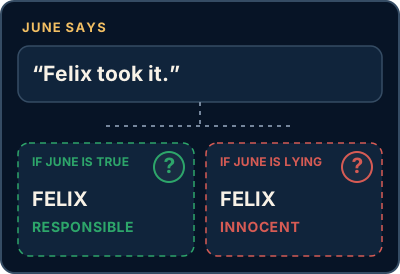
That's the first habit worth developing.
Don't just read what someone says. Think about what their statement would mean if it were true, and what it would mean if it were false.
Once you've proved someone is lying, you can use the opposite of what they said.
But be careful. Proving Felix innocent doesn't tell you who actually did it.
What does "June is lying" really tell us?
Now imagine Nora says:
"June is lying."
This creates an interesting relationship.
If Nora is telling the truth, June must be lying.
But if Nora is lying, June must be telling the truth.
Either way, exactly one of these two people is lying.
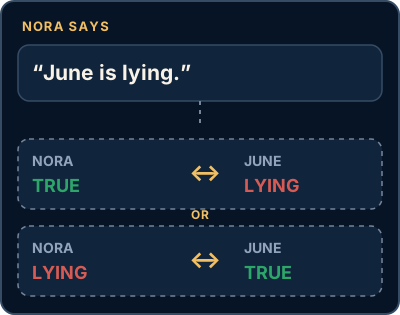
That's useful, even though we still don't know which person it is.
If the case tells us exactly two people are lying, we now know that one liar must be June or Nora, and the other must be someone else.
We've narrowed the possibilities without accusing anyone.
A liar isn't necessarily the culprit
This is one of the most important distinctions in Alibi.
Someone can lie about another suspect and still be innocent.
A truthful suspect could also be responsible, unless the case rules tell you otherwise.
For example, if a case says "The person responsible is lying," that gives us an additional rule.
Anyone we've proved truthful can be eliminated as the culprit.
But we can't automatically accuse someone just because we've proved they're lying.
There may be several liars, and only one person responsible.
Let's solve a small fictional case
A wooden token has disappeared.
Four people were nearby, and everyone has something to say.
Here's what we know:
Exactly two suspects are lying. The person who took the wooden token is lying.
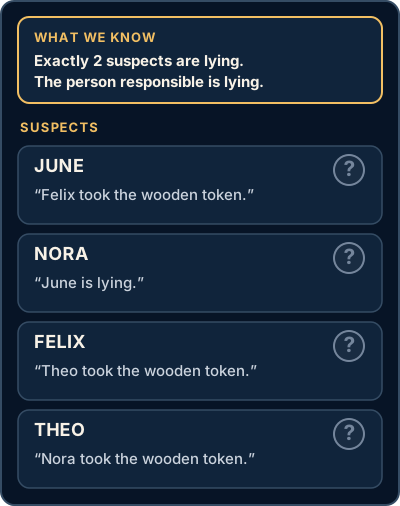
Before reading further, see if you can work out who took the wooden token.
Start with what we can prove
Nora says June is lying.
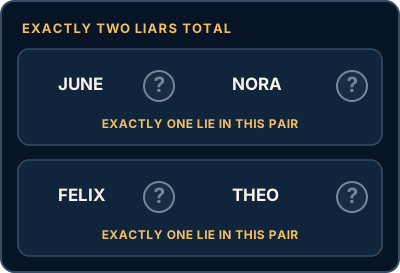
As we saw earlier, that guarantees exactly one liar between June and Nora.
The case says there are two liars altogether.
So exactly one of Felix and Theo must also be lying.
That's our first useful deduction.
Now use the other statements
Felix says Theo took the wooden token.
Theo says Nora took it.
We know exactly one of those two statements is true.
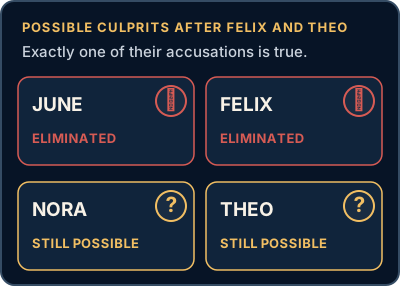
So the culprit must be either Theo or Nora.
Why? Because if neither Theo nor Nora took it, both statements would be lies. But we've already established that only one of Felix and Theo can be lying.
We've narrowed the culprit to two people.
Look for the final connection
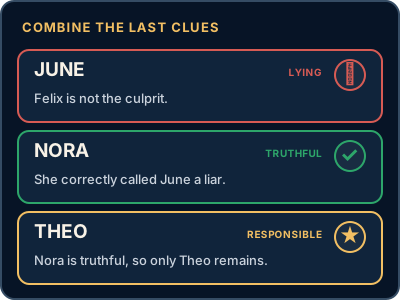
June said Felix took the wooden token.
But we've proved the culprit is either Theo or Nora.
That means June's statement is false.
June is lying.
And because Nora said June was lying, Nora must be telling the truth.
Now remember the case rule:
The person responsible is lying.
Nora is truthful, so she cannot be the culprit.
That leaves Theo.
Check the answer
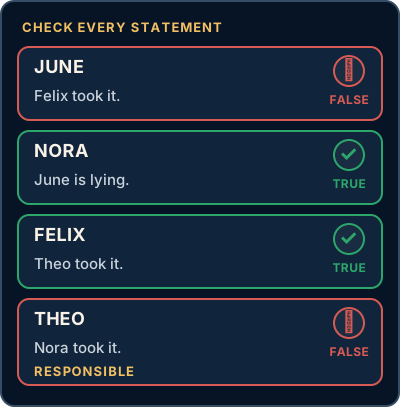
Let's make sure every statement agrees with our solution.
- June said Felix took it. False.
- Nora said June was lying. True.
- Felix said Theo took it. True.
- Theo said Nora took it. False.
Exactly two people lied: June and Theo.
And Theo, the person responsible, was lying.
Everything fits.
That's how we know our accusation is supported by the clues rather than just a guess.
How to apply deductions faster
You don't need to work through every possible culprit from scratch.
When you read a statement, ask yourself what kind of information it provides.
Does it identify or eliminate a suspect?
If someone says "Felix did it," proving the statement false clears Felix. It doesn't identify the real culprit.
Does it tell you who's lying?
A statement such as "June is lying" can link two people's truthfulness. You might be able to use that relationship before knowing who either person is.
Does it help you use the case's rules?
If you've proved that three people are lying and the case allows exactly three liars, everyone else must be truthful.
And if the culprit must be lying, every person you've proved truthful can be crossed off your suspect list.
The best deductions often come from combining two pieces of information that didn't seem especially useful on their own.
Give it a try
Next time you play Alibi, don't start by asking who looks guilty.
Start by asking:
What does this statement actually prove?
Mark a statement true or false when you have enough evidence. Use that information to revisit their statements, eliminate impossible suspects, and check how many liars remain.
You may find that the culprit becomes obvious long before you've worked out every detail of the case.
Play Alibi on Uncle Logic and see how quickly you can turn the statements into a solution.