

Crossed Wires: Why Four Green Tiles Might Not Mean You're Done
Imagine guessing a four-letter word and watching every tile turn green.
You'd probably expect the game to tell you that you've won.
But in Crossed Wires, four greens don't necessarily mean you've found either answer.
And that's where things get interesting.
Two hidden words, one set of clues
Crossed Wires hides two four-letter words. You have ten guesses to find both.
Each guess is checked against both hidden words, but you only see one row of feedback.
The colors work a little differently from an ordinary word game:
- Green: The letter is in the correct position in at least one hidden word.
- Yellow: The letter appears elsewhere in at least one hidden word.
- Gray: The letter doesn't match either active word under the game's feedback rules.
When the two words produce different colors for the same position, the game shows the stronger result.
That means one green tile might come from the first hidden word, while the next green comes from the second.
Let's see what that looks like.
How can four greens be wrong?
Imagine you enter the word WORD.
The game shows:

Four greens.
But neither wire has been untangled.
How is that possible?
Reveal where the four greens come from
Here's a fictional example of what could be hiding behind those clues.
The two secret words are WAND and SORE.
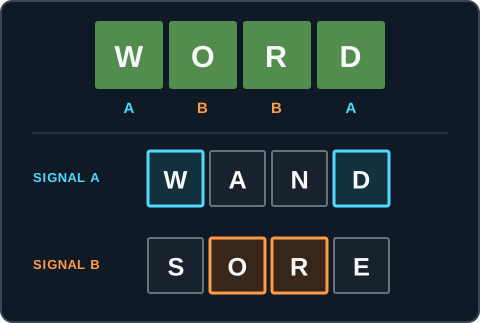
Look at where each green comes from:
- W matches the first letter of WAND.
- O matches the second letter of SORE.
- R matches the third letter of SORE.
- D matches the fourth letter of WAND.
Every green tile is telling the truth.
But WORD isn't WAND, and it isn't SORE.
The game combined correct information from two different answers into something that looks like a complete word.
That's the trick.
Four correct positions don't necessarily belong to the same hidden word.
Don't force two answers into one
Once you understand the merged feedback, the way you approach the puzzle changes.
Suppose you have two green letters in different positions.
It's tempting to build a single word around them.
But remember, those greens might belong to different hidden words.
That doesn't make them useless. They're still telling you something important about at least one of the answers.
You just don't know which one yet.
Instead of treating every green as part of the same word, think about possible complete words that could explain the clues.
A promising candidate is something you can test. It isn't something you've proved just because its letters fit the colors.
Finding one word changes everything
Here's where Crossed Wires gives you a break.
Once you guess one of the hidden words exactly, that wire is untangled.
From then on, the feedback comes only from the remaining word.
Let's return to our fictional example.
Imagine you've collected enough clues to suspect that WAND is one of the answers.
You guess WAND.
That word matches one hidden signal exactly, so the game reveals it.
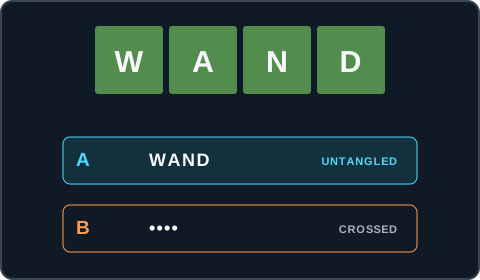
Now you're only trying to find SORE.
What would happen if your next guess were SORT?
Reveal the remaining word’s feedback
The feedback would show three greens and one gray:
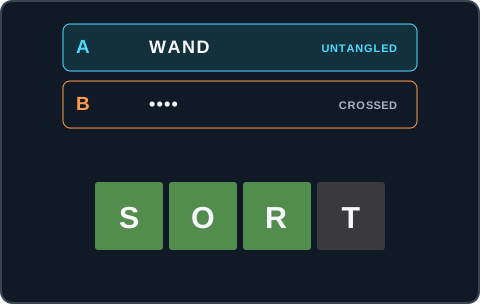
This time, all the feedback is coming from the same hidden word.
You know the remaining answer starts with SOR. You still need to figure out its final letter.
That's a much more familiar kind of word puzzle.
Notice that our earlier guess of WORD didn't prove WAND was an answer. We're using known words here to demonstrate how the clues change once one signal is found.
Make your guesses count
You only have ten guesses, so it's worth thinking about what each word might tell you.
Before entering a guess, ask yourself:
Am I testing a possible complete answer, or am I trying to learn something new?
Both can be useful.
A word that tests several possibilities might give you the information you need to identify one of the hidden signals.
And sometimes, testing a promising complete word is worth more than chasing another row of green tiles.
Most importantly, watch whether the game actually marks a wire as found.
That's how you know you've solved one of the two answers.
Give it a try
Next time you play Crossed Wires, don't assume four green tiles mean you're finished.
Think about which hidden word might be responsible for each clue.
Treat your guesses as evidence rather than a complete answer, and remember that the puzzle becomes simpler once you've found one word.
Play Crossed Wires on Uncle Logic and see if you can untangle both signals.