
Daily Puzzle: How to Turn Clues Into Answers
Some days, you open a puzzle and find a grid of numbers.
Other days, you're changing letters to make new words, deciphering a mysterious code, or trying to figure out which of several suspicious people is telling the truth.
Welcome to Uncle Logic's Daily Puzzle.
Unlike a game built around one set of rules, Daily Puzzle gives you a different kind of challenge from day to day. You might be comfortable with today's puzzle and completely unfamiliar with tomorrow's.
Fortunately, there's one skill that helps with almost all of them.
Learning to recognize what the clues are actually telling you.
First, figure out what you're trying to prove
Before solving anything, make sure you understand the question.
That sounds obvious. But it's surprisingly easy to start searching for an answer before you've worked out exactly what would make an answer correct.
Are you looking for a missing number? A sequence of valid words? A decoded message? The person responsible for a small mystery?
Each problem has a different goal, and that goal determines how you should use the clues.
Take a word ladder, for example.
If the instructions say each step must change exactly one letter and form a real word, finding a word that looks close to the destination isn't enough. Every step along the way must obey the rule.
Likewise, in a mystery where exactly one person is lying, finding a suspicious statement doesn't automatically identify the culprit. Your explanation still needs to satisfy the rule about how many people are lying.
The first useful question is often not "What's the answer?"
It's "What would have to be true for this answer to work?"
Separate what you know from what you suspect
Here's a habit worth developing: keep facts and possibilities separate.
Suppose a puzzle tells you that exactly one suspect is lying.
That's a fact established by the puzzle.
You might suspect a particular character is the liar because their statement sounds unusual. That's a possibility.
The difference matters.
If you start treating your suspicions as facts, everything you reason afterward can lead you in the wrong direction.
Instead, try asking:
- What does the puzzle explicitly tell me?
- What can I conclude from that information?
- What am I only assuming?
- Can I test that assumption against the other clues?
You don't necessarily need to write these questions down. With practice, they become a natural part of how you think through a puzzle.
And they can save you from spending several minutes confidently proving something that was never true in the first place.
Uncle Logic has some experience with that last part.
One clue rarely tells the whole story
Many good puzzles work by giving you pieces of information that become useful when combined.
A clue might eliminate one possibility. Another might restrict where something belongs. A third might connect those restrictions.
Individually, none gives you the complete answer.
Together, they can.
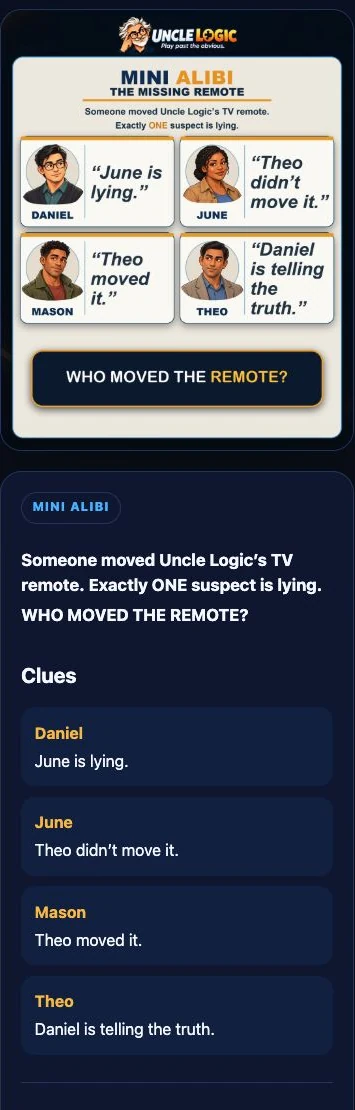
Imagine a mini alibi puzzle that says exactly one person is lying. You test a possible explanation, but it would require two people to have made false statements.
That possibility cannot be correct.
You haven't necessarily identified the culprit yet, but you've eliminated one explanation using the puzzle's own rules.
That's a genuine deduction.
And sometimes ruling out what cannot work is more useful than immediately trying to identify what does.
Different puzzles call for different approaches
Daily Puzzle includes several styles of challenge. They don't all solve the same way, but the habit of using every clue still applies.
Word ladders: Check every step
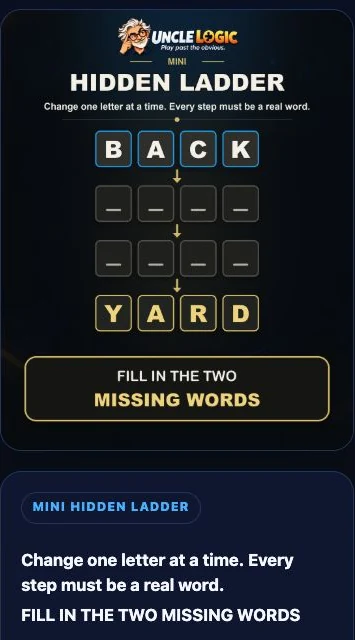
In a mini word ladder, the objective is to connect words by changing one letter at a time.
Don't concentrate so hard on reaching the final word that you overlook an invalid step in the middle.
If you're stuck, try working backward from the destination. A word that can connect directly to the ending may help you discover what belongs before it.
Just remember that every word along the route must still follow the rules.
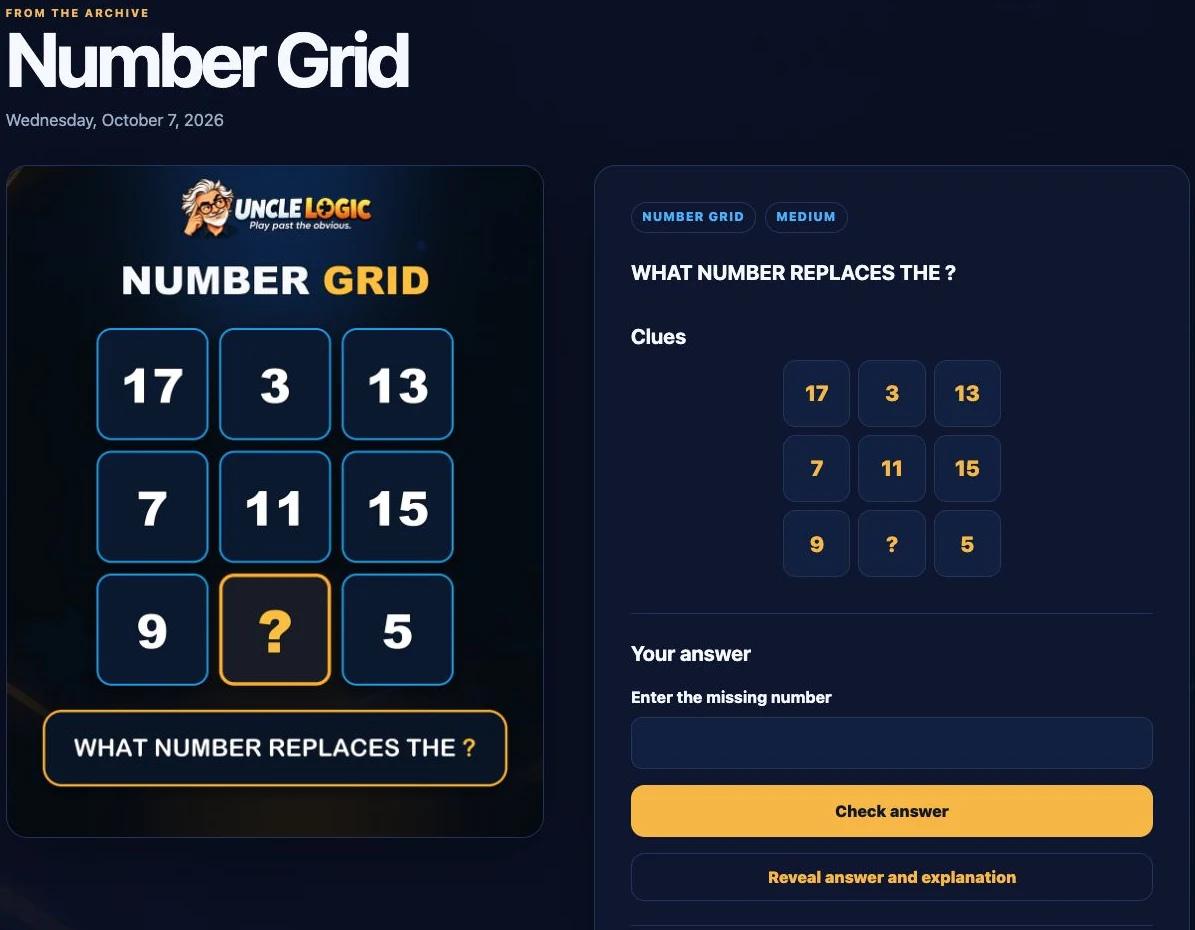
Number grids: Look for relationships
When numbers appear in a puzzle, it's tempting to immediately start adding, subtracting, or multiplying them.
Sometimes that's exactly what you need.
But first, identify the relationships established by the question and its clues.
If you think you've found a pattern, test whether it works everywhere it should. A rule that explains one part of a grid but contradicts another probably isn't the rule you're looking for.
Don't settle for a pattern simply because it looks promising.
Mystery codes: Test your interpretation
Codes invite experimentation.
You might notice a repeated symbol, a familiar letter pattern, or another relationship that suggests how a message is constructed.
That's a useful starting point, not necessarily a solution.
Try applying your proposed rule consistently. Does it explain the other parts of the code, or does it only work for the first example you noticed?
A convincing solution should account for the clues without requiring you to keep changing the rules.
Mini alibis: Make the statements agree
In a deduction mystery, you're often dealing with several statements that cannot all be true.
Start with the case's specific rules, especially any information about who might be lying.
Then test possible explanations.
If assuming one person's statement is true creates a contradiction elsewhere, you've learned something. If an explanation satisfies every statement and restriction, you may have found your answer.
Be careful not to confuse what a character claims with what the puzzle has established as fact.
That's usually where the interesting part begins.
Don't be afraid to work backward
We're accustomed to solving problems from beginning to end.
But many puzzles become easier when you start with what the finished answer must look like.
If you're filling in missing words between two known words, consider which words could connect to the ending.
If you're trying to identify a culprit, imagine one suspect is responsible and check whether every statement still makes sense.
If you're looking for a number, consider which values could satisfy the final restrictions before deciding how to reach them.
Working backward doesn't replace ordinary deduction. It's another way to find useful constraints.
And when you're stuck, changing direction is often more productive than repeating the same thought.
The explanation is part of the puzzle
One of my favorite things about Daily Puzzle is that the reasoning doesn't disappear when you reveal the answer.
Each challenge includes an explanation of why its solution works.
You can think of that explanation as more than a way to check whether you were right.
If you solved the puzzle, compare your reasoning with the explanation. Did you reach the answer the same way? Was there a simpler deduction you overlooked?
If you didn't solve it, look for the first step you hadn't considered.
Maybe you missed a restriction. Maybe two clues interacted in a way you didn't notice. Or maybe you had the right idea but didn't carry it far enough.
That's still useful.
Understanding why an answer works can teach you something you'll recognize in a completely different puzzle tomorrow.
And there's no requirement to stare at a problem indefinitely before revealing the reasoning.
The point is to learn something, not to win a staring contest with a grid of numbers.
Found a puzzle style you enjoy? Keep going.
Daily Puzzle is a good place to encounter different kinds of reasoning. It's also a way to discover which kinds you enjoy most.
If the word ladders are your favorite, Hidden Ladder takes the idea further by hiding the destination and giving you new information with each move.
If you enjoy figuring out who's telling the truth, Alibi turns that style of deduction into a complete mystery.
And if working through number-based restrictions is what interests you, Daily Sudoku offers Classic and Killer puzzles with their own sets of logical challenges.
You don't have to play every game. But occasionally, a small puzzle introduces you to an idea that's worth exploring further.
A different challenge tomorrow
The nice thing about Daily Puzzle is that you don't have to become an expert in one particular type of puzzle to enjoy it.
Some days you'll recognize exactly what to do.
Other days, you'll need a minute just to figure out what kind of problem you're looking at.
That's part of the appeal.
Read the question. Find the rules. Separate facts from guesses. Test your possibilities. And when you're ready, see how the explanation fits everything together.
Even if you don't get today's answer, you might recognize tomorrow's first deduction a little faster.
And that's progress worth making.