

Hidden Ladder: How to Make Every Word Count
In a normal word ladder, you know the word you're trying to reach.
Hidden Ladder makes things a little trickier. You know where you're starting, but you have to figure out where you're going.
Every word you enter does two things. It moves you one step along the ladder and gives you a clue about the hidden destination.
The trick is finding words that help you do both.
One letter at a time
You can only change one letter per move, and the result has to be a real word.
For example, CAPE → TAPE is a valid move. Only the first letter changed.
A jump that changes three letters wouldn't work. Even if you figure out the hidden word, you still need a valid route to reach it.
Pay attention to the colors
Every word you submit tells you something about the hidden target.
- Green: Right letter, right position.
- Yellow: The letter is in the hidden word, but somewhere else.
- Gray: No matching copy remains for that letter.
If you repeat a letter, one copy can be green or yellow while an extra copy is gray.
Green letters are especially useful because they tell you what you've already found. But don't ignore yellow. Sometimes a yellow letter tells you exactly what you need to work toward.
Let's try a small ladder
Imagine you're starting with CAPE. The destination is hidden. The game colors the starting word for free, before you've made a move.
Its A is green, P is yellow, and C and E are gray. Let's try TAPE, changing only the first letter.
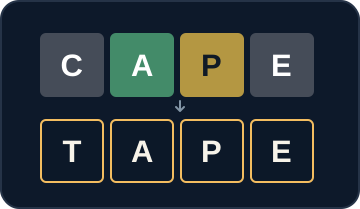
What do we learn when we submit it?
Reveal TAPE's feedback
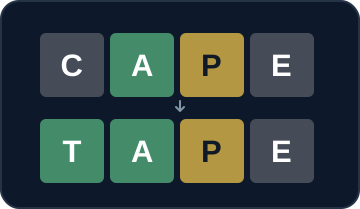
T and A are green. P is yellow, and E is gray.
The first two positions are taken. P can't stay in the third position, so it must be the fourth letter. We're looking for T A _ P.
We don't know the third letter yet. What valid move could help us test it?
Reveal the next move
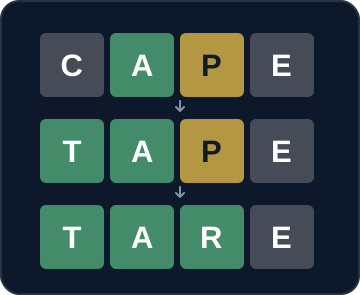
TAPE → TARE changes just one letter. This time T, A, and R all turn green. E is still gray.
Now we know the target begins with TAR. Add the yellow P from our earlier guess, and the destination is TARP.
We've found it. How can we reach it from TARE?
Reveal the final move
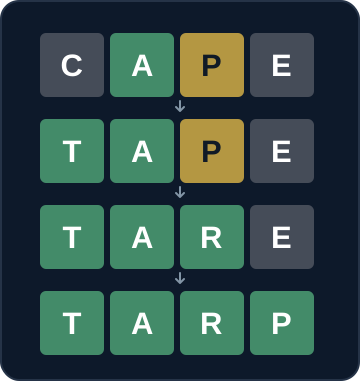
TARE → TARP changes E to P. The ladder is complete in three moves.
A good guess isn't always the shortest move
Our example used three valid moves, and each one helped us learn something. But real puzzles aren't always so straightforward.
Sometimes a word gives you several promising colors but leaves you in an awkward position. You might need an extra move to get somewhere useful.
You may even need to change a green letter temporarily to find a route forward. That's okay. You're solving two problems at once: figuring out the hidden word and finding a path to it.
Each accepted move counts toward your total. Undo and Restart don't erase that cost.
Think before you type
Before entering your next word, ask yourself two questions:
What can I learn from this word?
And:
Where can I go after it?
A word that tests an unknown letter might be useful, but it's even better when it also opens up a promising next step.
You won't always find the shortest possible ladder, especially when the destination starts hidden. The goal is to use what you've learned instead of making random changes and hoping for the best.
Give it a try
Next time you play Hidden Ladder, take a moment to study the colors before choosing your next word.
Think about which letters you've found, which ones need to move, and what valid words you can reach from where you are.
Sometimes one good word is enough to make the rest of the ladder fall into place.
Play Hidden Ladder on Uncle Logic and see how much information you can get from each move.