
Kakuro: A Beginner's Guide to Finding Numbers Without Guessing
If you've ever looked at a Kakuro puzzle and thought, "Is this Sudoku? A crossword? Some kind of math test?" you're not alone.
At first glance, Kakuro can seem a little intimidating.
There are boxes, numbers tucked into diagonally divided squares, and a lot of empty spaces. If you're used to Sudoku, you might recognize the idea of filling a grid with numbers, but the rules don't work quite the same way.
The good news? Kakuro is much easier to understand than it first appears.
You don't need to be particularly good at math, and you certainly don't need to start filling squares with random numbers and hoping they work.
You just need to understand what the clues mean.
Let's start there.
So, what exactly is Kakuro?
The simplest way to describe Kakuro is a crossword puzzle that uses numbers instead of letters.
In a crossword, you're given clues that help you fill words across and down.
In Kakuro, you're given sums that help you fill numbers across and down.
Your job is to place digits from 1 through 9 into the empty squares so that every horizontal and vertical group adds up to its clue.
There's one other important rule: you cannot repeat a digit within the same group.
That's really the foundation of the entire game.
There are no complicated equations to solve. You're working with simple addition, possible combinations, and logical elimination.
And like Sudoku, the interesting part is figuring out where things must go.
Understanding the grid
Before trying to solve anything, let's make sure you know what you're looking at.
A Kakuro grid has two basic types of squares.
Empty squares are where you'll enter numbers. Each one needs a digit from 1 to 9.
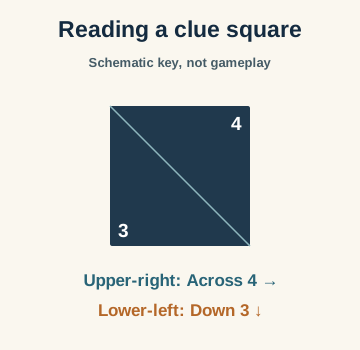
Clue squares are the darker squares that contain numbers, often divided by a diagonal line. Those numbers tell you what the neighboring empty squares must add up to.
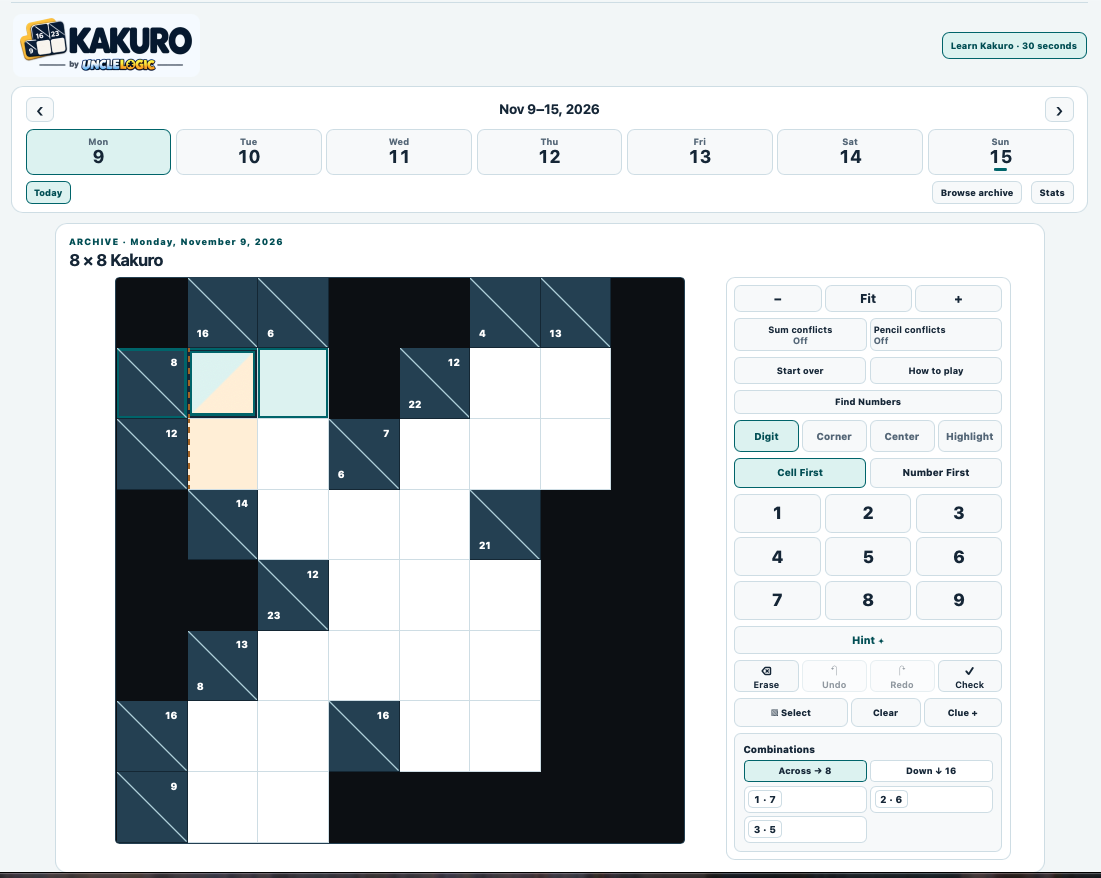
A clue for a horizontal group tells you the total of the empty squares extending to the right.
A clue for a vertical group tells you the total of the empty squares extending downward.
Each uninterrupted group of empty squares is called a run.
For example, imagine a clue of 7 followed by three empty squares.
Those three squares must contain numbers that add up to 7.
You could use 1, 2, and 4.
You couldn't use 2, 2, and 3, even though those numbers also add up to 7.
Why?
Because the number 2 would appear twice in the same run.
That brings us to the rule that makes Kakuro interesting.
The rule that makes everything work
In Kakuro, a digit cannot appear more than once within the same horizontal or vertical run.
That might sound familiar if you play Sudoku, but there's an important difference.
In Sudoku, every row, column, and 3×3 box has its own restrictions.
In Kakuro, the restrictions belong to the individual runs. A digit might appear elsewhere in the same row or column, provided it belongs to a different run.
This distinction is worth remembering, especially if you're coming from Sudoku.
Let's look at a simple example.
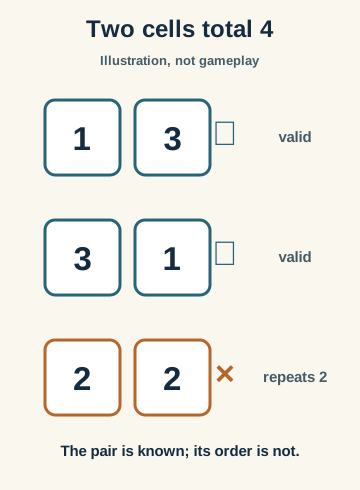
Suppose two empty squares must add up to 4.
What numbers could you use?
You might initially think:
- 1 + 3 = 4
- 2 + 2 = 4
But the second possibility breaks the no-repeating rule.
So your only valid combination is 1 and 3.
You don't know which square contains the 1 and which contains the 3 yet.
But you've already learned something useful.
Both squares are restricted to those two numbers.
And you didn't have to guess.
Finding your first numbers
Some Kakuro clues are much more useful than others when you're just getting started.
For example:
| Run | Required numbers |
|---|---|
| Two squares totaling 3 | 1 and 2 |
| Two squares totaling 4 | 1 and 3 |
| Two squares totaling 17 | 8 and 9 |
| Three squares totaling 6 | 1, 2, and 3 |
Each of these clues has only one possible combination of different digits.
That doesn't mean you know their positions immediately. But it does mean you know exactly which numbers must appear in the run.
These are excellent places to start a puzzle.
Rather than tackling the first empty square you see, look around the board for a clue that gives you very few possibilities.
The smallest totals and some of the largest totals are often particularly helpful.
Once you've identified the possible digits in one run, you can use that information to help solve another.
And that's where Kakuro starts to click.
Where two clues meet
Here's the part that makes Kakuro more than a collection of little addition problems.
Each empty square belongs to a horizontal run and a vertical run.
Whatever number you place in that square must satisfy both clues.
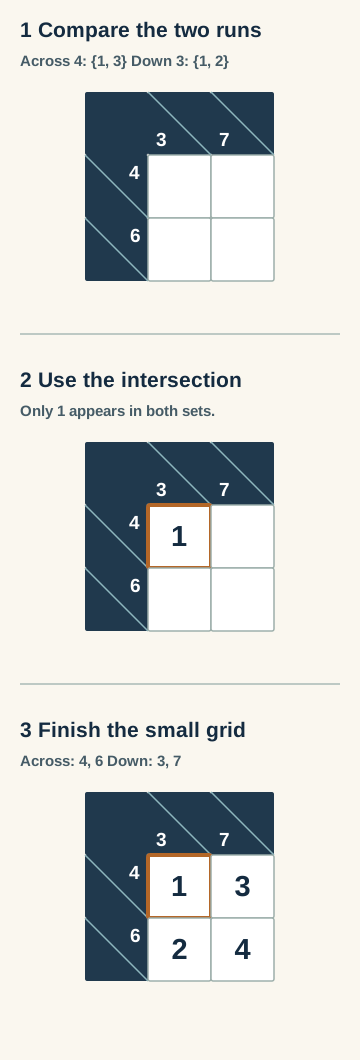
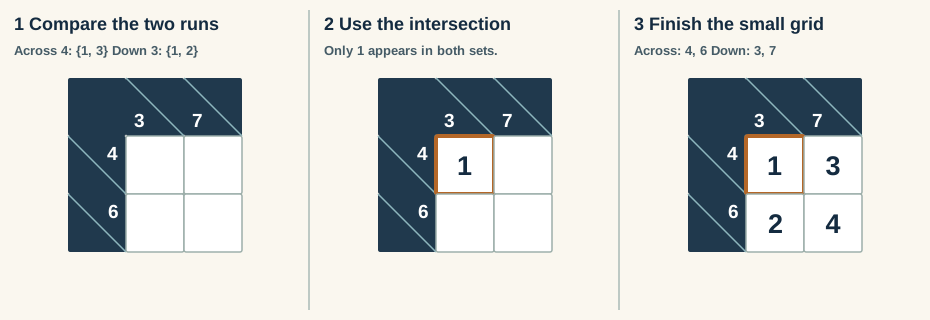
Imagine that one square belongs to two different runs:
- The horizontal run has two squares totaling 4.
- The vertical run has two squares totaling 3.
We already know that the horizontal run must contain 1 and 3.
We also know that the vertical run must contain 1 and 2.
Now look at the square where those two runs cross.
It must contain a number that works in both.
The horizontal run allows 1 or 3.
The vertical run allows 1 or 2.
The only number they have in common is 1.
So the crossing square must be 1.
Now everything else becomes easier.
The other square in the horizontal run must be 3, because 1 + 3 = 4.
The other square in the vertical run must be 2, because 1 + 2 = 3.
One small deduction has given you three confirmed numbers.
No guessing. No trial and error. Just using the information already on the board.
That's the basic idea behind solving Kakuro.
What if a clue has several possibilities?
Not every run will give you such a convenient starting point.
Suppose two squares need to add up to 12.
There are several valid combinations:
- 3 and 9
- 4 and 8
- 5 and 7
You can't immediately decide which pair belongs there.
And that's fine.
You don't need to solve every clue the moment you encounter it.
Instead, look at the other runs crossing those squares.
Maybe one crossing clue rules out 9. Another might eliminate 4 or 5.
As you solve nearby squares, the possibilities get smaller.
Eventually, you may discover that only one combination fits.
If the game provides a notes or pencil-mark feature, this is a good time to use it. Otherwise, you can keep track of a few possibilities as you work through the puzzle.
The important thing is to remember that not knowing a number yet doesn't mean you aren't making progress.
Every eliminated possibility brings you closer.
Three habits that make Kakuro easier
Once you understand the rules, a few simple habits can make your first puzzles much more manageable.
1. Start with the most restrictive clues
Look for runs that have only one possible combination, especially short runs with very small or very large totals.
They give you useful information immediately, even before you know the positions of the digits.
2. Check the crossing runs
Whenever you narrow down the possibilities in one direction, check what that means for the other direction.
A number that seems possible horizontally might be impossible vertically.
That intersection is often what turns a possibility into a confirmed placement.
3. Recheck the totals after every deduction
When you place a number, look at both runs it belongs to.
Have you eliminated a possible combination? Is there now only one number that can finish a run? Have you accidentally repeated a digit?
Don't rush to another part of the grid before taking advantage of what you've just learned.
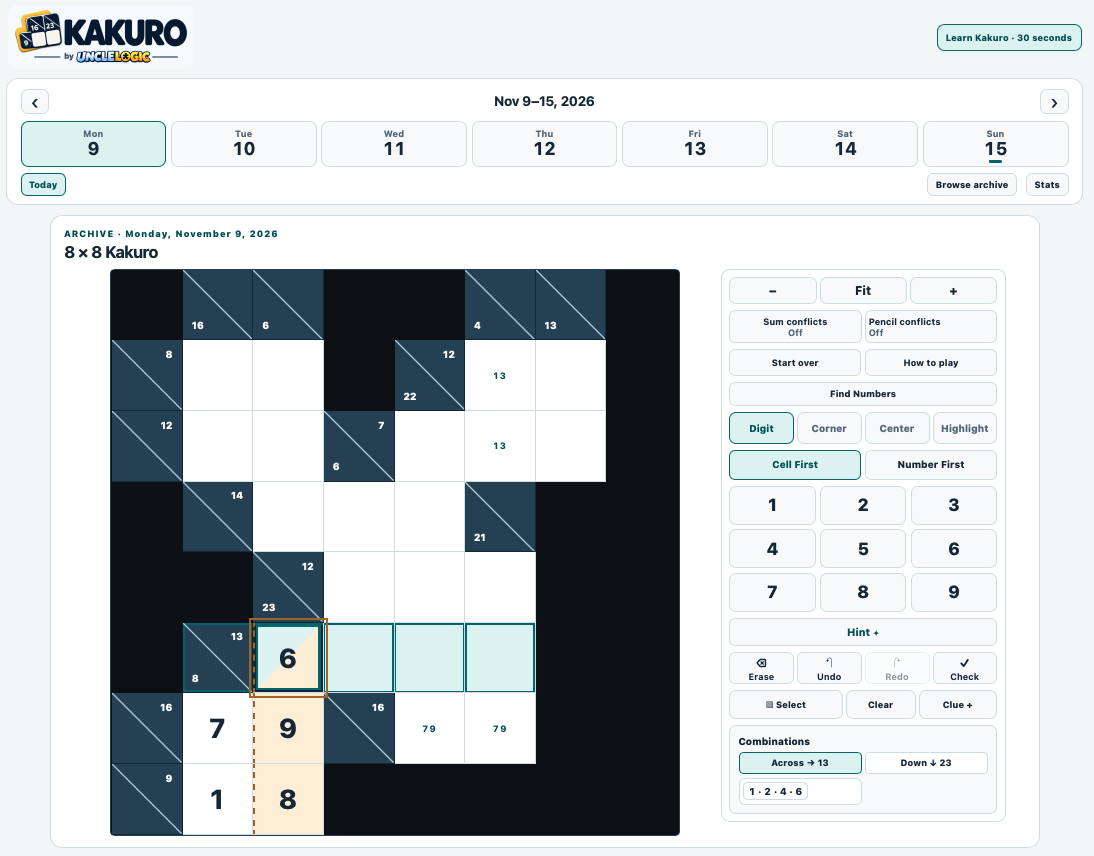
Sometimes one confirmed number unlocks several more.
Do you need to be good at math?
Not particularly.
Kakuro uses addition, but the real challenge isn't performing difficult calculations.
It's recognizing which combinations are possible and figuring out which ones satisfy all the clues.
Over time, you'll begin remembering some of the most common combinations without having to calculate them.
A two-square total of 17? That's 8 and 9.
Three squares totaling 6? That's 1, 2, and 3.
You'll start spotting these relationships automatically, much like an experienced Sudoku player recognizes a familiar pattern.
And if you're already comfortable with Sudoku, you have a head start. You're used to eliminating candidates and recognizing when only one possibility remains.
Kakuro simply gives you a different set of restrictions to work with.
When you're stuck, don't guess
One of the easiest mistakes to make in Kakuro is choosing a number that seems reasonable and continuing as if it must be correct.
Sometimes you'll get lucky.
Other times, you'll spend several minutes solving a puzzle built on a mistake you made much earlier.
Instead, look for a place where the available information is strongest.
Revisit a short run. Check its possible combinations. Compare the horizontal and vertical restrictions. Look at what has changed since your last confirmed placement.
You don't have to solve the entire puzzle at once.
You only need to find the next number you can justify.
And once you find it, the next step may become a little easier.
Give Kakuro a few minutes
If you're new to Kakuro, don't be surprised if your first puzzle feels unfamiliar.
You're learning to read a different kind of grid, and that can take a little adjustment.
But once you understand how sums, non-repeating digits, and crossing runs work together, the puzzle begins to feel much more approachable.
What first looked like a crowded board of numbers becomes a series of small logical questions.
Which digits can make this total?
Which of those digits also work in the crossing run?
What can I eliminate?
And eventually, which number must go here?
That's the satisfaction of Kakuro.
You aren't filling squares because a number looks right.
You're filling them because you've figured out why it has to be right.
And that's a pretty good feeling.
Ready to give it a try? Explore Kakuro on Uncle Logic.