

How to Solve Two Lockstep Boards That Move Together
In Lockstep, you can see where each piece needs to go. The hard part is getting them both there using the same moves.
You press Right to help one piece, only to realize the other one is heading the wrong way.
Here's the trick: sometimes you actually want one of your pieces to get stuck.
One move, two results
Every time you choose a direction, both pieces try to move one square that way.
But if one piece hits a lock tile or the edge of its board, it stays put. The other piece can still move.
That difference is what makes Lockstep interesting. Instead of treating every blocked move as a problem, start looking for ways to use it.
Try this small example
Imagine two 4×4 boards with no lock tiles. The filled circles are your pieces, and the rings are their goals.
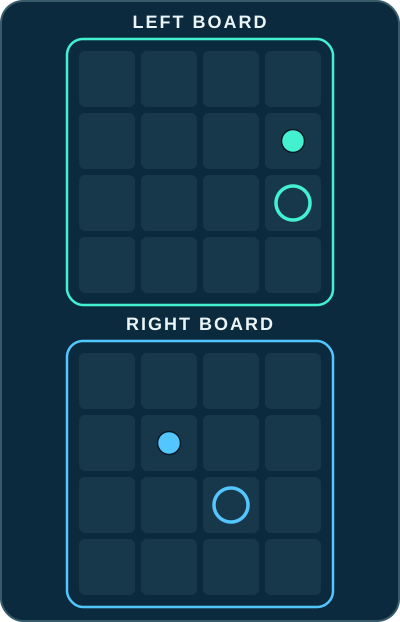
On the left board, your piece is already against the right edge. Its goal is directly below it. On the right board, your piece needs to move one square right and one square down.
So what happens if we press Right?
Reveal the Right move
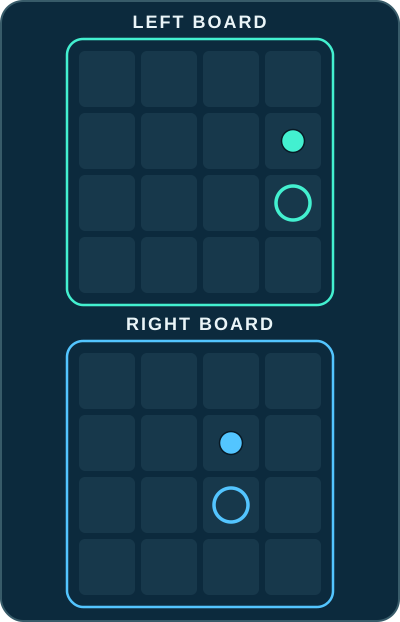
The left piece can't move. It's already at the edge. But the right piece moves one square closer to its goal.
Now press Down. Where will both pieces land?
Reveal the Down move
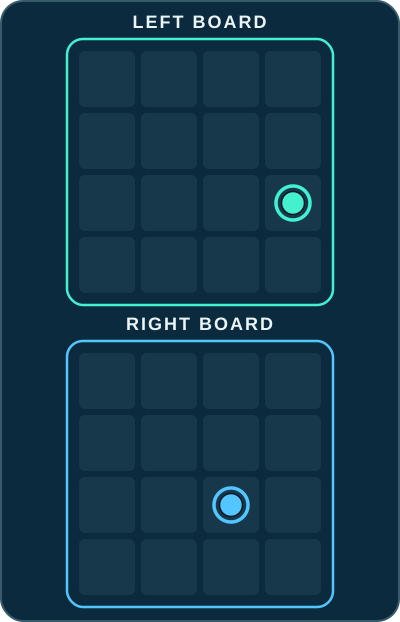
Both pieces move down onto their goals. Two moves, both boards solved.
The move that looked useless on the left board was exactly what we needed on the right.
Try working backward
Here's another useful habit. Instead of immediately moving toward whichever goal looks closer, imagine the last move of the puzzle.
Could both pieces reach their goals by moving Down? If so, where would each piece need to be just before that move?
In our example, the left piece was already in the right position for the final Down. The right piece wasn't. That tells us what to work on first.
We don't need to move both pieces closer to their goals with every input. Sometimes we only need to fix the position of one.
Don't fight the walls
When you're stuck, look at both boards and ask yourself:
- Can one piece stay still while the other moves?
- Is there an edge or lock tile I can use to make that happen?
- Can I work backward from the goals to find a useful final move?
Also, remember that getting one piece onto its goal doesn't necessarily finish the puzzle. You need both pieces on their goals at the same time. That's why rushing straight toward the nearest goal can make things harder.
Give it a try
Next time you play Lockstep, pay attention whenever one piece hits a lock tile or an edge. Instead of thinking you've wasted a move, look at what happened on the other board. You might have just created the opening you needed.
And once you've found a solution, try looking for a shorter sequence. Some puzzles can be solved in fewer moves than you first expect.
Play today's Lockstep on Uncle Logic and see if you can make getting stuck work in your favor.