
What Is a Puzzle Adventure Book? A Different Way to Read and Solve
Most puzzle books are pretty straightforward.
You open to a page, solve a crossword or Sudoku, and move on to the next puzzle whenever you're ready.
But what if solving the puzzle didn't just give you an answer?
What if it told you which page to read next?
That's the idea behind a puzzle adventure book, a different kind of puzzle experience where solving challenges helps you discover a story.
A book you don't read from beginning to end
In an ordinary puzzle collection, the order usually doesn't matter much.
You can skip a word search, come back to a crossword, or start with the Sudoku section. Each puzzle generally stands on its own.
A story-based puzzle book connects those experiences.
Instead of simply moving from page 12 to page 13, you might solve something on page 12 and discover that your next destination is page 47.
You turn there, find another piece of the story, and encounter your next challenge.
The puzzles aren't just activities along the way. They're how you find your way through the book.
This is sometimes called non-linear reading, because the order in which you visit the pages isn't the ordinary numerical order.

How does a puzzle adventure actually work?
Let's imagine a completely fictional example.
You open an adventure to page 12.
There's a short piece of the story about a missing delivery, followed by a small code puzzle.

Show the complete alphabet key
You solve the code and discover the number 47.
See how the code gives 47

Instead of turning to page 13, you turn to page 47.
There, the story continues. Perhaps you've arrived at a post office where nobody can remember who sent the letter.
Turn to the fictional page 47

Another puzzle is waiting, and its answer will tell you where to go next.
That's the basic process:
Read a little. Solve a puzzle. Discover your next destination. Keep going.
Of course, not every puzzle adventure follows exactly the same rules. Some use hidden clues, maps, or other forms of navigation.
The important distinction is that the puzzles help determine how you move through the experience.
Is that the same as a choose-your-own-adventure book?
Not necessarily.
In a branching adventure, you might choose whether to enter a mysterious building or follow a stranger down the road. Different decisions can lead to different parts of the story.
A puzzle adventure can work differently.
Instead of choosing your preferred direction, you solve a challenge to discover the intended next destination.
There may be one complete journey waiting to be uncovered, even though its pages are arranged out of order.
You're not necessarily deciding what happens in the story.
You're figuring out how to find it.
That creates a different kind of satisfaction. Each completed puzzle feels like opening another small part of the adventure.

What kinds of puzzles can you find?
A puzzle adventure doesn't have to rely on one type of challenge.
Word puzzles, number puzzles, visual puzzles, and logic problems can all work within the format.
A crossword might lead you to one destination. A cryptogram could reveal another. A Sudoku or nonogram might require an entirely different kind of thinking.
That variety can make a mixed logic puzzle book especially enjoyable.
Instead of repeating the same solving technique over and over, you're regularly changing how you approach the next challenge.
And because the puzzles connect to a larger experience, finishing one can feel like more than checking another item off a list.
An example: The Town in the Margins
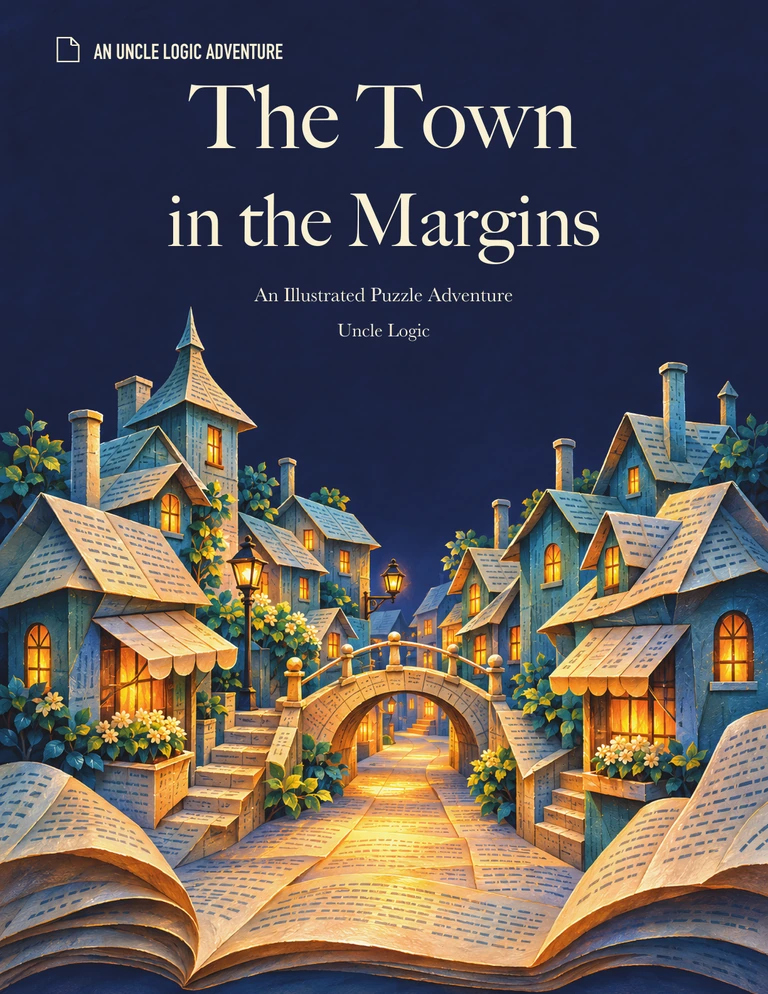
We wanted to explore this idea with our own illustrated puzzle adventure, The Town in the Margins.
The story takes place in Foldside Lane, a tiny town tucked between the footnotes and page margins.
Its roofs are made from folded newsprint. Laundry hangs from binding thread. And the whole place has been marked as spare paper for recycling.
Uncle Logic has a letter to deliver to Bea, the town's former mail sorter.
There's just one problem.
The letter keeps coming back.
As the reader, you help Uncle Logic search for Bea, meet the neighbors, and discover what's happening to Foldside Lane.
But you don't simply read the adventure from the first page to the last.
You solve puzzles to discover where the story goes next.
The book includes 96 puzzle stops across 17 different puzzle types, including crosswords, Sudoku, cryptograms, nonograms, mazes, and more.
There's one intended journey through the story, rather than a collection of branching endings.
And you don't need an app, special equipment, or an elaborate collection of physical clues.
The book and a pencil are enough.
Who might enjoy a puzzle adventure?
If you enjoy solving puzzles but sometimes wish they felt connected to something larger, this format might be worth exploring.
It combines the familiar satisfaction of pencil-and-paper puzzles with the curiosity of following a story.
It's also a screen-free activity you can enjoy at your own pace.
You can work through the challenges alone, or share the solving with somebody beside you.
And for someone who already owns plenty of conventional puzzle collections, an illustrated puzzle adventure could make an unusual gift.
The important thing is enjoying both sides of the experience: working out the answers and discovering what comes next.
The next page is part of the puzzle
A traditional puzzle book asks you to find the solution.
A puzzle adventure asks you to find the solution and then follow where it leads.
Sometimes that means jumping forward several pages. Sometimes it means going backward. And sometimes a small puzzle reveals a surprisingly important piece of the story.
You still get the familiar satisfaction of solving a crossword, deciphering a code, or completing a logic grid.
But now there's another question waiting after every answer:
Where does the adventure take you next?