
Killer Sudoku: Understanding Cages and Sums
If you've played regular Sudoku, you already know most of what you need to play Killer Sudoku.
The difference is those little dotted boxes with numbers in the corners. They're called cages, and they can help you solve a puzzle before you've placed your first number.
What changes in Killer Sudoku?
The normal Sudoku rules still apply. Every row, column, and 3×3 box must contain the numbers 1 through 9 without repeating any.
Killer Sudoku adds two more rules:
- The numbers inside each dotted cage must add up to the small total shown in its corner.
- Numbers cannot repeat within the same cage, even when its cells are in different rows or boxes.
Those two rules give you another way to work out where numbers belong.
Start with the easiest cages
Imagine a cage containing just two squares. Its total is 3. What two different numbers between 1 and 9 can add up to 3?
Try the two-square cage totaling 17, too.
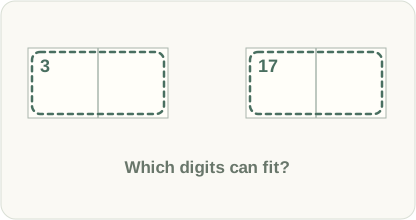
Show the combinations
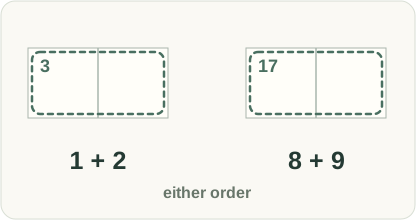
Only 1 and 2 make 3. Only 8 and 9 make 17. In both cages, either order is still possible.
Not every cage has just one combination. A two-square cage totaling 10 could contain 1 and 9, 2 and 8, 3 and 7, or 4 and 6. You need another clue to narrow it down.
Use regular Sudoku rules to place the digits
Now put the 3 cage vertically. We know its digits are 1 and 2. A 1 is already visible in the top square's row. Which digit goes on top?
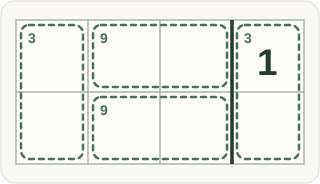
Show where the digits go
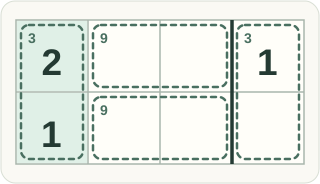
The top square cannot be another 1, so it must be 2. The bottom square is 1. The cage gave us the pair. The row rule fixed their positions.
Every row, column, and box adds up to 45
Every complete row contains 1 through 9. Add them together and you get 45. The same is true for every column and every 3×3 box.
Here, three cages sit completely inside one box. They cover eight of its nine squares and total 5, 10, and 24. What must go in the ninth square?
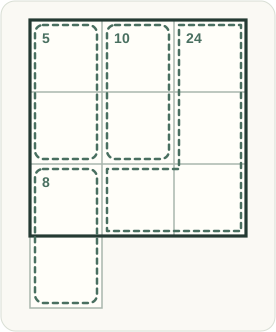
Show the missing digit
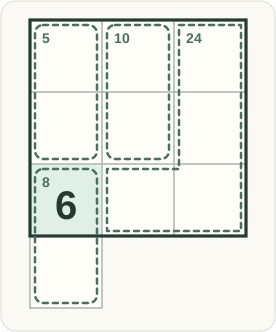
The three cages total 5 + 10 + 24 = 39. The box totals 45, so the remaining square is 45 − 39 = 6.
Watch the boundary when you use this trick. If a cage crosses out of the row, column, or box you're examining, you cannot count its whole total as though every cell were inside.
What should you look for first?
Start with small cages, especially ones with unusually low or high totals. A two-square cage totaling 3 or 17 is a good place to begin. Then check the row, column, and box rules to see where those digits can go.
If you get stuck, look for a row, column, or box where cage totals make the rule of 45 useful.
Knowing which numbers belong in a cage does not always tell you their positions. That's still progress. A few eliminated possibilities can unlock another part of the puzzle.
Give it a try
Killer Sudoku uses the same logic as regular Sudoku, with cage totals giving you extra clues. The next time a puzzle looks crowded with dotted lines, pick one small cage and see what it tells you.
Try it in Daily Variant Sudoku, where Killer Sudoku is the current variant.